Dear University of California,
What you are grappling with is not actually an admissions problem.
It’s a placement problem.
In case readers are not familiar:
UCSD recently released an in-depth report which found that—possibly UC-wide—around 12% of students are arriving on campus at a remedial/6th-grade math level.
A coalition of professors, particularly STEM faculty, signed an open letter calling for the reinstatement of the SAT as a prerequisite for STEM majors and an admissions requirement.
Most recently, anecdotal reports have emerged regarding remedial levels of reading and writing issues as well.
So far I have seen the following arguments:
• Students receive uneven preparation, possibly attributed to limited access to qualified instructors.
• Students are managing to earn As in AP courses without actually understanding the material.
• Students are enrolling in courses at the UCs inconsistent with their actual readiness.
None of these problems will be resolved by requiring the SAT.
The SAT has changed significantly in the past 20 years.
First of all, it’s adaptive. That means that not all students are being presented with the same questions.
The more you answer correctly, the harder it gets.
This is true for both sections.
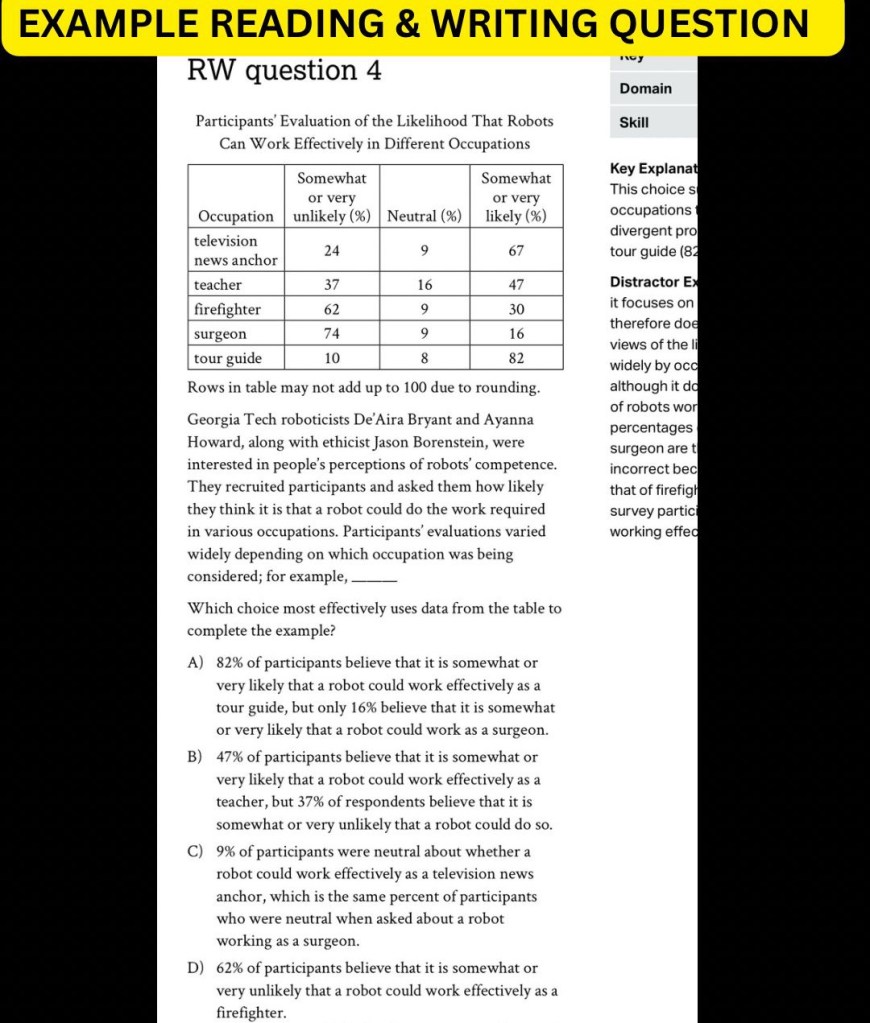
Secondly, the test is increasingly skill based rather than content based.
I personally became more aware of this when I reviewed a section of sample questions in the verbal portion of the test.
I was shocked to encounter questions that reminded me of the LSAT’s logic games.
Thirdly, the writing section has been eliminated entirely.
Students do not have an opportunity to showcase their writing skill.
The argument that students who are otherwise “unprepared” for the math at UCs will somehow magically be able to self-study via free tools like Khan Academy is misguided.
Students who perform well on the SAT are well versed in SAT test-taking strategy. In my experience, this is typically achieved via expensive private tutoring and prep courses.
What will most certainly occur, if the SAT requirement is reinstated, is that students who have lower access to subject matter experts (i.e., more experienced math teachers—to paraphrase from the professor’s article) will be faced with the exceedingly unlikely Sisyphean task of somehow figuring out how to teach themselves the math that their math teachers could not teach them effectively via Khan Academy.
Not only is this an unlikely solution, it would appear it may be entirely unnecessary.
The SBAC is a similarly problematic solution for two main reasons:
(1) Only 12(+) states use the SBAC.
(2) It seems likely, statistically, that the lesser resourced districts’ students will underperform in a manner similar to the SAT. Though possibly slightly better, due to test design differences.
I am a member of a Facebook group that is run by one of the UC application readers. Based on what I have observed there, read in the news, and seen from UC official accounts, I happen to believe that the UCs do a commendable job in deciding who to admit.
One thing I have not seen explicitly addressed is that admissions isn’t only about identifying current ability.
It’s also about identifying potential.
If you agree with me, arguendo, that admissions does a good job of identifying both students with current ability and those who have potential, then the problem isn’t actually about readiness at admission.
The problem is actually about identifying which students are not currently in a position to take certain courses.
That can be fixed, immediately, with placement tests.
I have two children who will attend UCs in the fall.
I was quite surprised to learn that the placement process is different at each campus.
UC Berkeley does not have a proctored Math placement test.
UC Davis does not have a proctored Writing placement test.
Requiring both Math & English placement tests for all incoming freshmen will immediately identify which students need remedial coursework.
Anecdotally, UC Berkeley very recently posted its “recommended but not required” Math placement test, and my daughter took it. Both daughters thus took the two different UC Math placement tests, and got results they felt were consistent with their self perceived math readiness. In other words, they felt the assessments were a representative measure of their abilities.
Uniform placement tests will allow the UCs to compare all students apples to apples in rendering placement.
In addition to placement tests, UC Berkeley has historically had many different programs designed to address readiness.
For example, Fall Program for First Semester (FPF), which provided students with “curated curriculum and proactive advising,” seemed well positioned to offer scaffolding to students.
It was recently & suddenly discontinued, for publicly unknown reasons.
24 years ago, UC Berkeley would divert some of its accepted students to local community colleges to complete core courses.
While I believe this was due to space constraints, it stands to reason that such programs could easily be created to funnel cohorts of students needing remedial level courses as another alternative.
I do not want Calculus professors teaching remedial math. Not only is it a waste of their time & talents, but it is also unlikely to improve outcomes for students who do not belong in a Calculus course.
If 88% of students are not at a remedial level, then the number of students requiring remedial courses is relatively small, and likely would not require significant institutional change.
The UCs should strive to protect their admissions process that balances many factors including geographic diversity.
Students from lower resourced districts are much more likely to come from urban and rural districts. Their life experiences matter and have an impact on the campus culture. They should not be penalized because their districts were unable to provide the quality of instruction that the higher resourced suburban districts did.
State funding may be roughly equal, but many people don’t realize that affluent districts raise millions of dollars each year to enhance educational outcomes.
I urge you: Don’t burn down the house to roast the pig.
Respectfully Submitted.


Leave a Reply